
AI-Driven AR and VR: Revolutionizing Personalization, Interaction, and Industry Transformation

AI in Augmented Reality (AR) & Virtual Reality (VR): Enhancing Experiences Across Industries
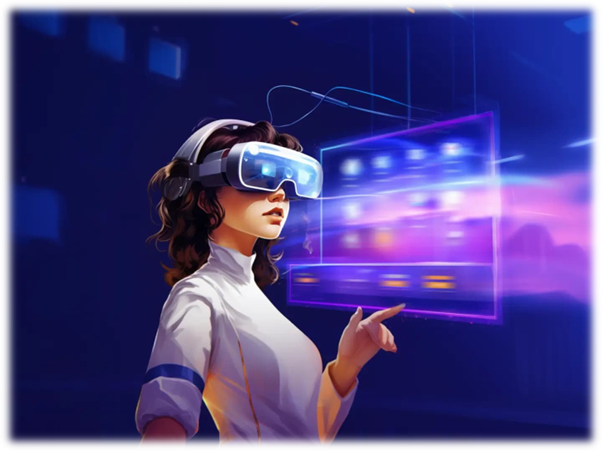
Artificial intelligence (AI), augmented reality (AR), and virtual reality (VR) are the three most revolutionary technologies that will influence how digital experiences are created in the future. Whereas VR submerges users in entirely virtual worlds, AR overlays digital material over the physical world. AI is essential to advancing these technologies as it can simulate human decision-making and perception. Combining AI with AR and VR can achieve new interactivity, immersion, and personalization levels. Industries, including education, healthcare, and entertainment, are being greatly impacted by this convergence, which is bringing about breakthroughs that were unfathomable a few years ago.
How AI Enhances AR/VR Experiences
Personalized User Experiences
AI can process and analyze Massive volumes of data to provide individualized AR and VR experiences. AI-driven systems can dynamically customize content by gaining knowledge from user’s behaviors, preferences, and environments. AI in augmented reality may tailor overlays to display pertinent data depending on what the user is looking at or engaging with. In the retail industry, for example, AI may provide product recommendations based on user interests while browsing AR-enabled catalogs. By adjusting to user preferences, AI in VR personalizes virtual worlds. Examples of this include modifying a game’s difficulty level or learning modules based on a user’s progress in an educational setting. Artificial intelligence (AI) can simulate users’ activities in real time, adding a more natural and immersive feel to virtual worlds.
Natural Interaction and Recognition
Enhanced Content Creation
Industry Impact: Education, Healthcare, and Entertainment
Education
Healthcare
Entertainment
Perhaps the entertainment sector is one of the first sectors to use AI in AR and VR to provide more realistic and interactive content. AI is used in games to improve non-playable characters’ (NPCs’) behavior in virtual worlds, giving them a more realistic appearance and reactivity to player input. Because AI is used to make decisions, this results in dynamic storytelling experiences where every playthrough seems unique. AI-powered Virtual reality (VR) has the potential to provide highly participatory virtual theatre or music events where the emotions and responses of the audience impact the course of the performance. AI also makes it possible to create individualized entertainment experiences, such as VR environments and stories that adapt to the preferences and interactions of the user to provide each user with a unique, immersive experience. Working with the best virtual reality developers ensures these experiences are built to the highest technical and creative standards.
Conclusion: The Future of AI in AR and VR
Our interactions with digital content are changing due to AI’s integration with AR and VR, resulting in more responsive, immersive, and adaptable experiences. These technologies will transform education, healthcare, and entertainment as they continue to converge, increasing the connectivity and significance of digital encounters. In conclusion, AI is not only improving AR and VR; instead, it is radically changing how these technologies are employed and expanding the realms of possibility across several sectors. Partnering with the best virtual reality developers can help organizations harness these innovations effectively and bring world-class immersive experiences to life.


How LLMs Are Revolutionizing Text Mining and Data Extraction from Unstructured Data
How Businesses Use LLMs for Competitive Intelligence to Stay Ahead of the Curve

Maximizing Cost-Efficient Performance: Best Practices for Scaling Data Warehouses in Snowflake

Implementing Snowflake Data Governance for Scalable Data Security